
Threading Tools for Precision Engineering & CNC Tapping and Thread forming
Our threading tools include solid carbide thread mills, thread whirl cutters, high-quality taps, external threading tools and long-reach threading and tapping tools.
The Hahnreiter HSSE tapping tools form the core of our threading tools range, providing reliable thread cutting tools for general-purpose materials, while Dummel and Seco threading tools offer solutions for demanding applications. We hold strong stock levels and can ship all in-stock threading tools within one working day – Contact our sales team on 01376 347566 today.
For high value components and difficult applications where the risk of tapping tool breakage is simply not an option, Sutton Tools UK can also provide a solution for high-quality results. We provide various options of thread mill tooling to enable the operator to generate the thread for through and blind holes. Hence, solid carbide thread mills are available in both the Seco and Fetoga ranges. Thread whirl cutters are also available which are perfect for small thread sizes or difficult materials.
If you require long reach thread milling, we have answers for that too. Our Dummel and Seco ranges of indexable thread milling tooling are both effective and flexible and just one option of the variety of products available. You can achieve many different types of thread forms and sizes using a small range of holders and an extensive range of replaceable inserts. Ideal for CNC production.
Featured Threading Tool
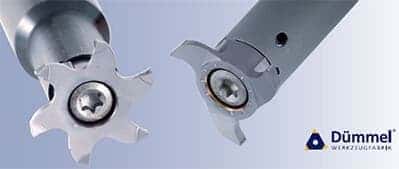
Dümmel Minimill
The Dümmel Minimill system is the ultimate threading tool for milling by circular interpolation from 10mm. The interchangeable carbide inserts have a proven three-rib coupling that guarantees optimal concentricity. Tool holders are available in Steel, Carbide, and Densimet. Insert options range from general groove milling, DIN standard circlip groovers, keyway milling, full radius, chamfering, and threading. A well-established system for thread milling, the Dummel Minimill thread screw profiles include Metric, UN, Whitworth, and BSP.


Threading and Tapping FAQs
What is Threading in Engineering?
Threading in engineering is the process of creating helical ridges on a component using threading tools, such as thread dies, thread cutting tools or thread mills. These tools produce external or internal threads so components can fasten securely.This method of metal processing allows a screw to fasten to another material.
These processes are usually mentioned together as they are similar processes, although tapping tools create screw threads on the inside of nuts etc. which is where the threaded screw fastens.
What is a Threading Tool?
Threading tools cut screw threads. Held by die stocks, these are also referred to as die holders.
Threading in manufacturing is the process used to create screw threads. Methods to generate these are subtractive, deformative or transformative, additive, or a combination of these.
What is a Tapping Tool?
In machining, this tool allows you to create screw threads within a pre-tapped hole, a process known as tapping. Some applications allow for tapped holes without the need for this by using a thread tapping tool.
Subtractive Methods of Threading
Subtractive methods include thread cutting and thread grinding using threading tools.
Thread Cutting
Use a thread cutting tool when:
- There is a small quantity
- You need full thread depth
- You are threading up to a shoulder
- The blank is inaccurate
- The material is brittle
- You require a tapered thread
Taps and Dies:
Tap and die tools are common threading tools. Hand taps cannot cut thread in a single motion as they quickly jam from long chips and there is no feature to automatically remove the chips. Whereas, continuous tapping operations use “gun” or specialised spiral point taps which automatically remove the chips to resolve jamming.
Single-point Threading:
Single-point threading is a thread-cutting method to produce a thread form onto a cone or cylinder using a single-point thread cutting tool. A single-point tool moves horizontally whilst the workpiece’s rotation determines the thread pattern. The single-point method can be used to produce external or internal threads.
Thread Milling:
If a suitable helical toolpath is available, a milling cutter rotates to create threads. Thread milling, when compared to tap and dies and single-point thread tools, has the advantages of less tool breakage, faster cycle times, and the same tool creates left- or right-handed thread.
Other thread-cutting methods include thrilling and helical broaching.
Thread Grinding
Thread grinding uses grinding wheels that match the thread’s shape and is done on a grinding machine.
Other Methods of Threading
Deformative and transformative methods of threading include thread rolling and forming, as well as moulding and casting, whereas additive methods include 3D printing.
What is the Use of Tapping Tool?
A tapping tool cuts screw threads. A tap tool is similar to a screw though it has bolt like threads and two, three, or four flutes or grooves that are longitudinal. This tool is cuts screw threads in nuts.
What are the Types of Tapping Tools?
There are 4 types of tapping tools: spiral fuse tap, straight flute tap, spiral point tap, and forming tap.
Spiral Fuse Tap:
This tap cuts off chips and lifts them out using its spiralling flutes, essentially cleaning out swarf as it cuts. Therefore, this tap type should only be used where swarf congestion is a concern in blind holes as it is weak.
Straight Flute Tap:
A typical style of tap used across various tapping applications. A straight flute tap creates blind or through holes and is particularly beneficial for cutting short chipping material.
Spiral Point Tap:
This tap type machines through holes as it is the strongest thread-cutting tap. A spiral point tap has a lefthanded spiral sheer at its tip with straight flutes so that the swarf is ejected in front of the thread.
Forming Tap:
A forming tap creates the strongest thread as it doesn’t produce any chips, but rather moves material to the thread.
What is the Difference Between a Drill Bit and a Tapping Tool?
Tapping and drilling are both used to create holes in metal. However, drilling uses a drill bit that doesn’t have a thread pattern to follow as it pushes to cut through. Whereas tapping uses a tap that has a specified thread path to cut pre-existing threads following a bolt or screw.
What is the difference between thread cutting and thread forming?
Thread cutting removes material using edges on the tool, producing chips. Thread forming tools displace material instead of cutting, creating stronger threads with improved surface finish and no chip evacuation issues.
When should die nuts be used?
Die nuts are ideal for repairing, resizing or cleaning external threads on bolts and shafts. They are commonly used in maintenance, rework and workshop repair operations.
What are the advantages of using thread mills?
Thread mills provide superior control, reduced tool breakage risk and the ability to cut different types of thread forms with one tool holder. They are ideal for CNC machining and difficult materials.
How do I choose the right tapping tool for my material?
Material hardness, ductility, hole type and thread depth determine the best tapping tool. For example, spiral flute taps work best for blind holes, while forming taps suit ductile materials.